
Choosing the right line marking services Sydney provider is not just about comparing quotes. Road and infrastructure projects need a contractor who understands the specified marking system, surface condition, traffic exposure, application requirements and project handover. A suitable solution must meet the project’s documented requirements while supporting visibility, safety and practical maintenance.
For council engineers, civil contractors, infrastructure managers and procurement teams, the selection process should start with the project specification and end with a clearly defined scope of work. This guide explains how to assess road marking contractors, compare materials and identify the questions worth resolving before awarding a contract.
What should you look for in line marking services Sydney?
Look for a contractor with relevant project experience, suitable equipment, a clear material recommendation, a documented preparation process and the capacity to work within your project’s access and traffic-management arrangements. Make sure you ask for evidence rather than relying on general promises of quality or durability.
Check relevant experience and accreditation
Road marking for a local access road, a high-traffic intersection and a coloured cycleway can involve different materials, application requirements and acceptance criteria. Ask prospective contractors about comparable projects, their role in delivery and the quality checks used to verify completed work. Also, where accreditation is required by the client or contract, confirm its current status and relevance to the proposed work.
Review the scope, programme and handover
Before comparing prices, establish whether each proposal covers the same work. The scope should identify marking dimensions, quantities, colours, materials, preparation, access arrangements, traffic management responsibilities and exclusions.
Ask how the contractor will coordinate with other construction activities, manage work staging, and confirm when marked areas can be returned to service. The programme should account for the selected product’s application conditions and specified drying or curing requirements.
Which road marking materials suit your project?
The right material depends on the marking’s purpose, the substrate, expected traffic, required performance, application conditions and the governing specification. CAP, thermoplastic and waterborne paint each have appropriate uses. The contractor should explain why its recommendation suits the actual project rather than applying one system by default.
Cold applied plastic and high-friction surface treatment
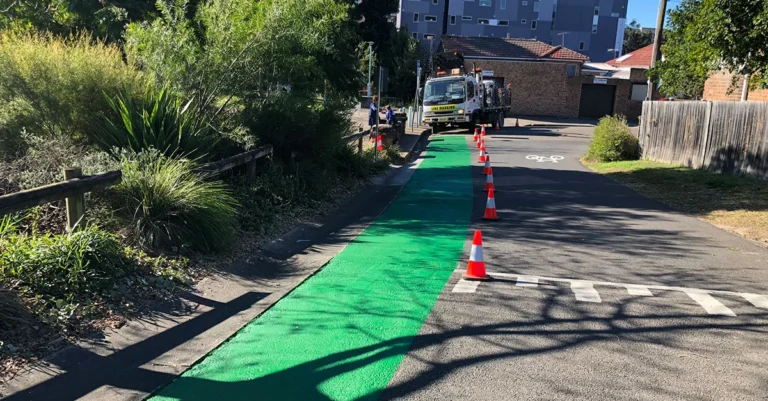
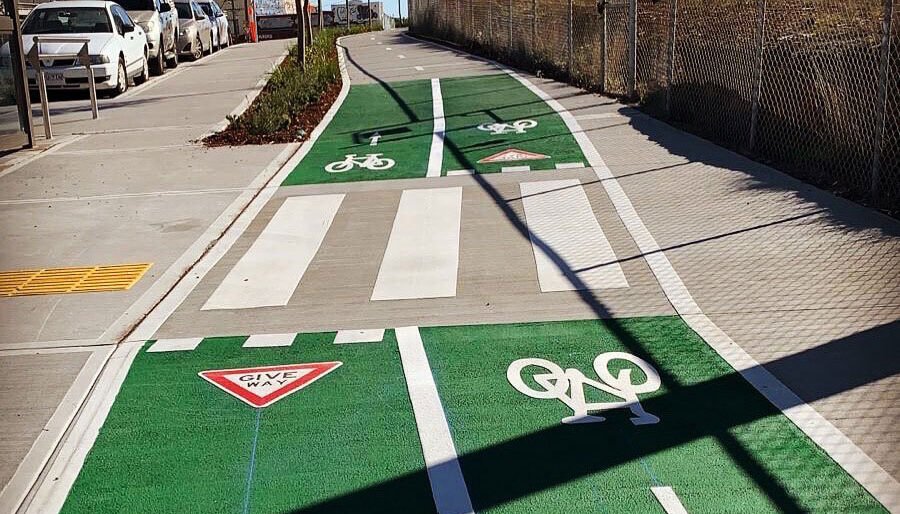
Cold applied plastic (CAP) is used for selected coloured road surfaces, including cycleways and bus lanes. Depending on the system, it can combine coloured material and aggregate to create a defined surface finish and provide skid-resistance performance.
For projects involving high-friction surface treatment, ask what performance is required, how it will be assessed and whether the proposed system has evidence relevant to the specified application. Confirm the product, aggregate, application method and substrate requirements rather than treating all CAP products as interchangeable.
In general, CAP may be suitable where a project calls for coloured surfacing and specific surface-performance characteristics. However, its suitability must still be assessed against the design, traffic conditions and applicable specification.
Thermoplastic line marking Sydney projects may require
Thermoplastic is used for many road and pavement markings, including lines, symbols, arrows and lettering where the specified system calls for it. Its application involves controlled heating and appropriate equipment, so the contractor should explain how material handling, substrate condition, and application requirements will be managed.
So, when evaluating thermoplastic line marking Sydney providers, ask how the proposed product matches the specified marking type, whether reflective beads or other components are required, and what inspection criteria will apply.
Waterborne paint for specified applications
Waterborne road-marking paint may be appropriate for projects where the specification, traffic exposure, surface and operational requirements support its use. It may also be specified for particular temporary or permanent markings, depending on the contract.
Ask the contractor to explain expected performance, application conditions, and maintenance implications for the proposed product. A lower initial price does not automatically mean better value, but a more expensive material is not automatically the right choice either.
Thermoplastic is used for many road and pavement markings, including lines, symbols, arrows and lettering where the specified system calls for it. Its application involves controlled heating and appropriate equipment, so the contractor should explain how material handling, substrate condition, and application requirements will be managed.
So, when evaluating thermoplastic line marking Sydney providers, ask how the proposed product matches the specified marking type, whether reflective beads or other components are required, and what inspection criteria will apply.
Waterborne paint for specified applications
Waterborne road-marking paint may be appropriate for projects where the specification, traffic exposure, surface and operational requirements support its use. It may also be specified for particular temporary or permanent markings, depending on the contract.
Ask the contractor to explain expected performance, application conditions, and maintenance implications for the proposed product. A lower initial price does not automatically mean better value, but a more expensive material is not automatically the right choice either.
CAP vs thermoplastic vs waterborne paint
| Factor | Cold applied plastic | Thermoplastic | Waterborne paint |
| Typical application | Selected coloured surfacing and specialist marking systems | Specified road lines, symbols and pavement markings | Road markings where the specified system is suitable |
| Surface suitability | Depends on the product, substrate and preparation | Depends on the product, substrate and application method | Depends on the paint system, substrate and application conditions |
| Key consideration | Surface performance, aggregate, colour and adhesion | Application temperature, material specification and installation quality | Drying conditions, substrate compatibility and required performance |
| Questions to ask | What performance evidence supports the proposed system? | How will application and inspection requirements be met? | Is paint specified and suitable for the intended service conditions? |
Note: Consider this comparison as an initial discussion guide, not as a substitute for the project specification or the manufacturer’s application requirements. The final selection should be supported by the current project documentation, the product’s technical information and the contractor’s explanation of suitability.
Why line marking surface preparation matters
Line marking surface preparation is fundamental to application quality. Dust, oil, loose material, moisture, deteriorated coatings, or an unsuitable substrate can affect adhesion and the finished result. Simply applying a new marking over a poorly prepared surface does not resolve the underlying problem.
Ask the contractor to inspect the existing pavement and explain the preparation method proposed for the actual conditions. This may involve cleaning, removing redundant markings, treating contamination or addressing other substrate issues, depending on the surface and marking system.
For road marking materials for asphalt and concrete, compatibility should be confirmed rather than assumed because the two substrates differ widely in texture, condition, and surface characteristics.
Also, do not forget to clarify how the contractor will assess weather and surface conditions before application, and what happens if those conditions fall outside the product’s requirements. These details are especially important when the work must fit a tightly staged road closure.
Which NSW pavement marking specifications apply?
Transport for NSW specifications R110 and R141 provide relevant technical guidance for specified coloured surfacing and pavement marking works. So, before selecting a marking system, confirm the applicable requirements against the latest Transport for NSW specifications, project drawings, contract documents and any referenced supplementary standards.
R110 is referenced for coloured surface treatments, including applications such as bus lanes and cycleways, and R141 relates to pavement marking. Their applicability depends on the work being specified; mentioning a specification alone does not establish that every product, installation or project is compliant.
Before awarding the work, ask the contractor to identify the relevant specification clauses and marking types, confirm the proposed system against those requirements, and explain how inspection and acceptance will be documented.
Where the contract specifies particular materials, dimensions, reflectivity, skid-resistance performance, installation procedures or acceptance tests, ensure the quote explicitly accounts for them. Resolve discrepancies between drawings, schedules and the contractor’s proposal before work begins.
How to compare road marking contractors Sydney
When comparing road marking contractors Sydney, evaluate the full scope and delivery approach rather than selecting the lowest headline price. A meaningful comparison requires each contractor to price the same quantities, materials, preparation tasks, and project responsibilities.
- Experience: Request evidence of comparable road or infrastructure projects.
- Materials: Confirm the proposed product and why it suits the application.
- Preparation: Identify cleaning, removal, and substrate-treatment requirements.
- Traffic management: Clarify who arranges approvals, closures, traffic control and access, as applicable.
- Programme: Confirm staging, application conditions and reopening requirements.
- Quality checks: Define inspection, testing and acceptance requirements.
- Exclusions: Identify additional costs, client responsibilities and assumptions.
- Handover: Specify required records, defect handling and maintenance advice.
These checks also help when evaluating commercial line marking Sydney providers for mixed-use developments, car park upgrades, or supporting infrastructure. Moreover, car park line marking Sydney and warehouse line marking Sydney may involve different operational requirements from public roads, so confirm that the contractor has relevant experience rather than assuming every marking job is equivalent.
How to plan for line marking durability and maintenance
Line marking durability and maintenance depend on the material, application quality, substrate condition, traffic loading, environmental exposure, and maintenance practices. No single lifespan applies to every road marking system or site.
Ask what maintenance assumptions underpin the proposed solution, how wear or loss of visibility should be monitored, and what conditions would trigger inspection or remarking. If the project requires performance testing, agree on the test method, timing, acceptance criteria and reporting before work starts.
For larger infrastructure programmes, coordinate marking installation with pavement works and other contractors. The sequence can affect surface condition, access, marking protection and the amount of rework required. Make sure you record the agreed scope and acceptance criteria so the completed work can be assessed consistently.
Road marking contractor checklist
Before appointing a contractor, confirm each of the following:
- Relevant experience and required accreditation have been checked.
- Current drawings, specifications and acceptance requirements are understood.
- The proposed material is suitable for the substrate and intended use.
- Surface preparation and redundant-marking removal are defined.
- Traffic management, staging and access responsibilities are agreed.
- Application conditions and reopening requirements are documented.
- Inspection, testing and handover records are specified.
- Quotes cover equivalent quantities, tasks, exclusions and responsibilities.
- Maintenance expectations and defect procedures are clear.
A contractor who can answer these questions clearly gives the project team a stronger basis for comparing proposals, managing delivery risks and assessing the finished work.
Frequently asked questions
Compare relevant project experience, accreditation where required, material suitability, surface preparation, traffic-management arrangements, quality checks and the completeness of each quote. Verify claims against project-specific evidence.
CAP is used in selected marking and coloured-surfacing systems, while thermoplastic is used for many specified road lines and symbols. The appropriate choice depends on the marking’s purpose, the product specification, substrate, and project requirements.
There is no universal best material. Selection depends on the substrate, intended use, traffic exposure, specified performance and product compatibility. So, confirm the proposed system against the project documents and manufacturer guidance.
R110 is referenced for coloured surface treatments, while R141 relates to pavement marking. Confirm the current documents and the exact requirements applicable to your project through Transport for NSW and the contract documentation.
Preparation helps provide a suitable substrate for the specified marking system. Contamination, moisture, loose material or unsuitable existing coatings can compromise adhesion and finished quality.
It should define quantities, marking types, materials, preparation, traffic-management responsibilities, staging, quality checks, exclusions and handover requirements. Compare quotes only after confirming that their scopes are equivalent.
Service life varies with the marking system, substrate, traffic, environment and installation quality. Ask for evidence relevant to the proposed application and agree on inspection and maintenance criteria rather than relying on a generic lifespan.
Disruption can often be managed through suitable staging, access planning and application scheduling, but the achievable level depends on site conditions and project constraints. Confirm the traffic-management plan and reopening requirements with the project team.
Discuss your Sydney road-marking project
Choosing a contractor is easier when the specification, surface conditions, materials and delivery responsibilities are clear from the outset. Colourcoat provides CAP, thermoplastic, waterborne paint and pavement-marking solutions for a range of road and surface applications.
You may review the relevant Colourcoat services or pavement-marking solutions or contact the team to discuss your project’s scope, requirements and site conditions before requesting a proposal.